Showing posts with label LA Times. Show all posts

Time for Wrters to Work Harder On Your Own Reliable Resources


Reliable Resources in Greater Danger as Time Goes On


My Love Affair with Reliable Resources 


By Carolyn Howard-Johnson,

 author of poetry, fiction and the Modern History Press’s acclaimed HowToDoItFrugally Series of book for writers


I fell in love with reliable resources when I became a staff writer for my high school newspaper and realized the acquisition of a deep love for that concept surpassed my original attraction for my high school’s Thunderbol. (Was mostly interested in the smart(and cute!) ivy leaguer group of who guys hung out there!) And for very good reason. It turned out the cute boys ignored me, but that being “reporter” who could support my position help me when our editor (or staff advisor) wanted to edit (or ax) one of my columns I could save it by pointing to a reliable resource that supported my viewpoint.


I learned more about the value of reliable resources again sometimes around the time CNN introduced the highlight of my weekend TV consumption; I viewed their Reliable Resources as a class in class in constitutional law and began to see the how close the relationship  to my chosen career of  journalism which by then  had served me well through a couple decades of assorted occupations. It was a TV one-of-a-kind and it never occurred to me it wouldn’t remain a staple of the cable station that brought believable news my way during several occasions when I also became aware of dishonesty coming from places I had until then trusted and admired (the Nixon era, and Vietnam and Iraq wars come to mind). It kept me from losing hope for better things to come so I could focus onbuilding a business and raising a family. 

I was appalled when it was cancelled in 2020. I literally mourned for its anchor Brian Stelter who someone managed to survive under the radar with his online Reliable Resources Newsletter. Had I been more of an internet aficionado, his new journey would have helped me avoid years of negativity. Even in these bad moments,  things were getting better. Not perfect but good enough to start believing in Camelot again.


Flash forward to slowly growing to love my hometown newspaper. It wasn’t The New York Times, but it was sure enough reliable. I even saw value in it their new management made a highly critiqued move. Though many didn’t agree in when they started re-labeling much of what had traditionally been identified by its placement the Opinion page. That page became “Opinion Voices” and even their columnists were targeted with headlines that carefully delineated in one word, VoicesYes, both bold and italicized. So did their new label, “guest contributors,” when editors felt that was needed—apparently to strengthen its stance on free speech because it helped readers more easily identify what the simple word opinion had managed to do for a long time across the breadth of trustworthy media.


I also follow ideas (and dangers to watch for) that come from PEN America. During her interim co-CEO stint and chief program officer, Summer Lopez, interim co-CEO and chief program office was among the first to warn of the then-recent revelation that a lawsuit by a sitting president was brought against Penguin Random House the world’s largest trade book publisher and two authors for publishing a book!


I’ve always been proud of PEN with its global membership of writers and literary professionals). I’ve even participated in some of PEN’s efforts to support young writers by sponsoring seminars, only one of the paths they use to support  our founding fathers’ determination to keep our country operating differently from the European countries they all hailed from. You know. FREE.


It turned out I had been ignoring the signals. I opened my daily newspapers to Lopez’s opinion piece dominating the LA Times Opinion page with the decree that reliable resources are in danger again. This administration seems to love the freedom afforded by our courts to speak our minds but tends to rely on diminishing other reliable resources like laws and precedence to govern. It’s clear enough: This lawsuit “against a book publisher” is a “dangerous escalation.”  I only hope that it doesn’t become the straw that broke the camel’s back. I hope that this time the back that gets broken is from that heavy load  known as “truth” hurled by writers themselves. All writers including authors of books and the powerhouse executives that publish their work. I hope they’ll all use the power of the pen to keep resources reliable before we lose the power of free press, free speech and, using Lopez’s words, “the freedom to write.”


MORE ABOUT THE “WRITERS-on-the-Move” COLUMNIST


Howard-Johnson is the recipient of the California Legislature’s Woman of the Year in Arts and Entertainment Award, and her community’s Character and Ethics award for her work promoting tolerance with her writing. She was also named to Pasadena Weekly’s list of “Fourteen San Gabriel Valley women who make life happen” and was given her community’s Diamond Award for Achievement in the Arts.  Carolyn writes nonfiction for writers, poetry, and fiction and has studied writing at Cambridge University in the United Kingdom; Herzen University in St. Petersburg, Russia; and Charles University, Prague, as well as several universities right here in the good ol’ USA. 


On Mourning the Loss of Ask Amy for Her Daily Wisdom with My Oatmeal and Coffee Each Morning


The Guest Blogger with Typewriter 
She Used  in Early Ann Landers Days

To #WritersontheMove Subscribers and Visitors:

Amy Dickinson just announced that she would be retiring her Ask Amy advice column after several decades of serving readers like me who enjoy learning from others’ mistakes and successes.  Unbeknownst to Amy, we have a history that goes way back and I am pretty sure it is unique after reading her columns (and her predecessor Ann Landers’ columns) for so long.  I hope you will find it interesting and help me help her celebrate doing something new with her writing from her home in New York State.  Here it is just as it appears in the snail mail I sent to her. 

Dear Amy,                                                                            June, 2024


Chapter Twenty-Two
Getting Questions Answered 
à la Ann Landers, Amy, or Eric

 
“There is only one thing better than learning from our own mistakes. It’s learning from the booboos, blunders, and gaffes of others.” ~ CHJ


So, dear reader, what if you didn’t get it right the first time! What if you feel frozen or depressed about an aspect of your review process? If you’ve read this book through, you probably suspect I don’t much like being told no or that there is only one right way to do something. It is part of my onward-and-upward-with-no-delays philosophy.

That’s one reason I love Q&A formats; they tend to highlight alternative views and illustrate what destructive thinking consists of. That love comes, in part, from some of my first experiences as a journalist. The editor at my first “real” writing job put me to work making Ann Landers’ columns fit into space allotted on page layouts the advertising and backshop departments had designed for what we then called the “Society” pages. (Advertising is where the money comes from that keeps newspapers’ presses rolling so they get first dibs on the available space on newspaper pages.) Sometimes there was not enough room for all of Ann’s letters so it was my duty to edit, cut, and fix so they fit and were still intelligible.

     In the process, I learned a lot in the letters about life’s little problems including the roadblocks similar to the ones we authors run into with reviews. Q&As are an easy way to identify problems and to make them understandable because they are anecdotal. So, you are going to get a few short Q&As that answer some questions about the review process that keep you awake at night. Sometimes they are questions about specifics, sometimes general. But they are exercises in learning from one another. All are adaptations of actual Q&As à la Ann Landers (or her Ask Amy successor!) that I use in the seminars I teach.  

###


PS: Amy, I am enjoying your reruns this month, too. Though I have to admit I have never seen one of those professed reruns when it was (theoritically) first published. Not once. Over all those decades I have been avidly reading your column.

How can that be? My memory isn’t what it once was, but I’m still not that forgetful and I couldn’t have missed more than a few of your columns while on vacation over the years. Just wondering…

And, please pass along good wishes to Eric, too!


Very best, your faithful reader, 

Success in 2024,
Carolyn Howard-Johnson


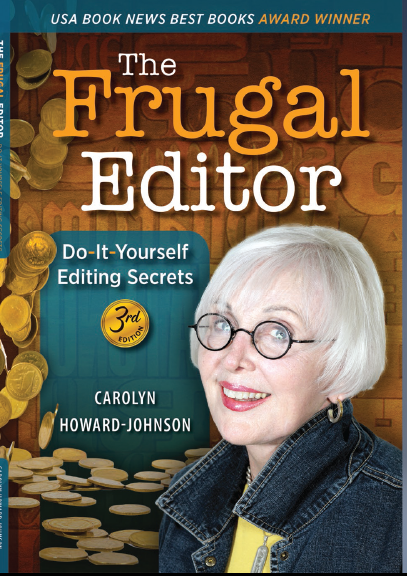
Promise yourself better editing of all your work—query letters to books--in 2024 
with the 3rd Edition of my “The Frugal Editor." 
 
NOW IN RELEASE ON AMAZON from
MODERN HISTORY PRESS

ADVANCE PRAISE
“…The Frugal Editor is part reference guide, part do-it-yourself editing manual, part masterclass on the writing and publishing industry…and all with Carolyn’s signature humor and encouraging energy! She is a master at simplifying overwhelming tasks into relevant, can-do information…” -Dallas Woodburn, best-selling author and book coach 

Cover by Doug West
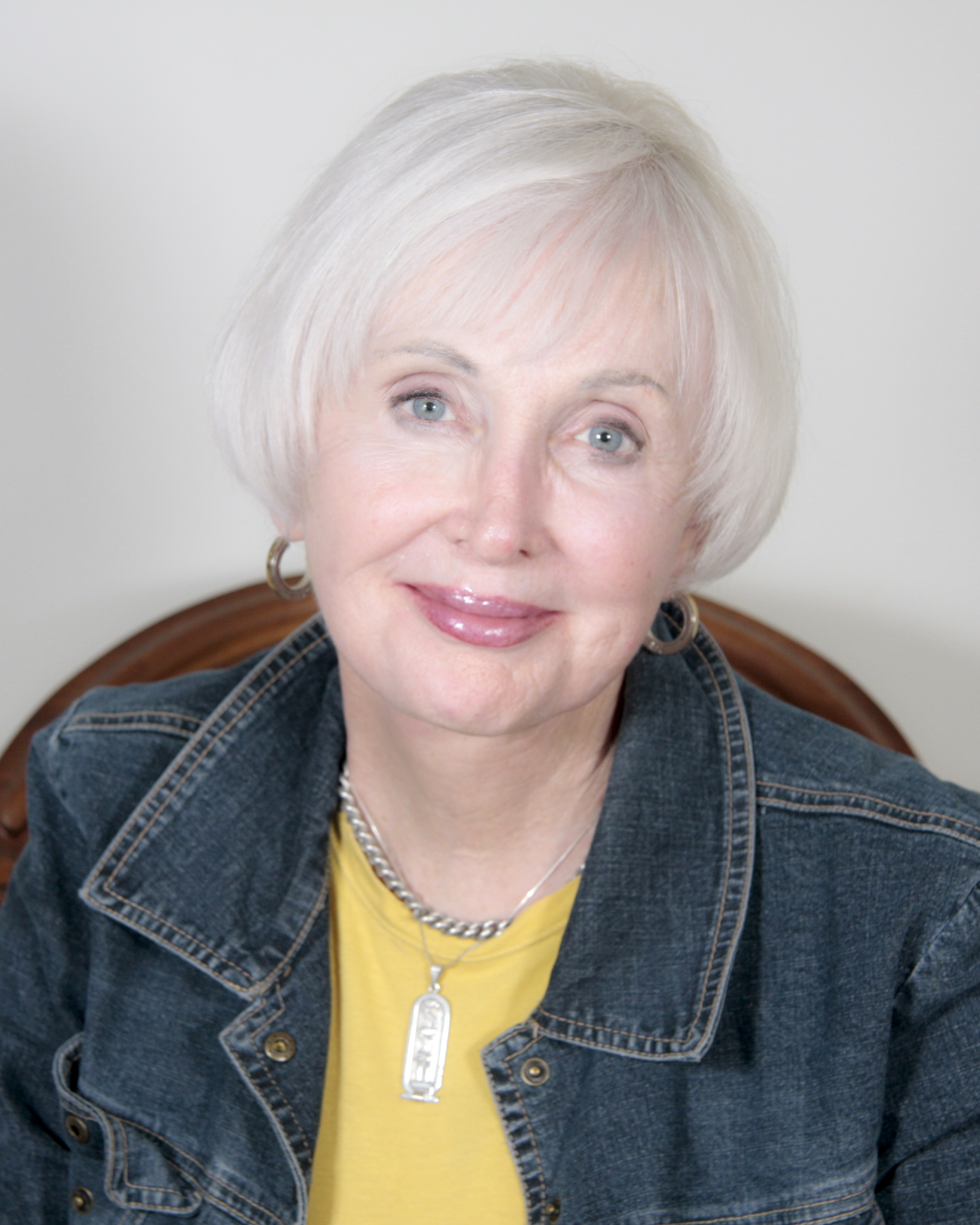
Headshot by Uriah Carr 
Amazon Series Page:
https://tinyurl.com/FrugalSeries
Blog:
http://SharingwithWriters.blogspot.com
Submit to my #SharingwithWriters blog: tinyurl.com/SubmittoMySWWBlog
Twitter: @FrugalBookPromo
Facebook:
http://facebook.com/carolynhowardjohnson
Amazon Profile: http://bit.ly/CarolynsAmznProfile
E-mail: hojonews@aol.com


PS: Learn more about my fiction and poetry at carolynhoward-johnson.com. [Do not use https or http with this. Use it as you see it-- naked. LOL.]


What George Orwell Has to Say About Words


What George Orwell Has To Say About It

Freedom of the Press and Words Count
 
By Carolyn Howard-Johnson
 
You may know me as “The Frugal Book Promoter”…or novelist. . .or poet. But because this year is shaping up to be an especially difficult year worldwide, maybe you won’t mind if I stray a bit from my usual topics to talk to you about topics that that have been in the news recently—namely freedom of the press and the importance of words?
 
Not long in the past during the height of the Covid pandemic, the White House issued a list of words the Center for Disease Control and Prevention shouldn’t use. That was unprecedented. It bothered me then and it bothers me even more now that Covid keeps reoccurring but some of the other major problems we face have exacerbated. We are lucky that as writers it has been relatively easy to isolate ourselves. That has made me even more appreciative of the importance of words in my life and, I hope, has done the same for you..
 
The LA Times (Tuesday, Jan 16, 2020 page B2) used this as a lead for the story on this repression of words, all the more surprising because the United States is known for its respect for words, both spoken and written:
 
“’It’s a beautiful thing, the destruction of words.’ George Orwell writes
in the fifth chapter of his dystopian novel, 1985.”
 
I love the novel the Times chose to quote, but I have always been too optimistic to give its dystopian theme much credence. But here we are with four public health experts from Emory University in Atlanta saying that if the CDC actually obeys the White House order to avoid certain words and phrases and that by doing so, it “squanders [the agency’s] limited resources.” Other agencies were also “forbidden” to use words like “vulnerable,” “entitlement,” “diversity,” “transgender,” “fetus,” “evidence-based” and “science based.” In some cases, the administration’s budget office suggested alternative terms which is a subtle way of saying they are not only telling them what words to avoid, but telling us what words they would like to them to use. I can only hope that this administration will return to honor the constitution’s freedom of speech and press intentions.
 
Then in a recent Sierra Club magazine (sources do count for us writers!), I learn that the US climate office was told not to use the terms “climate change,” “emissions reduction,” or “Paris agreement.” Seems someone was trying to control what we write about, maybe trying to control how we think.
 
Times also reported that in addition to our concepts of free speech and free press, gagging like this violates The Plain Writing Act of 2010 that requires all federal agencies “improve the effectiveness and accountability to the public by promoting clear Government communication that the public can understand and use.”
 
We writers should be thankful for that “plain writing” encouragement! But as writers, we should all be worried—even on the lookout—for anything that limits our use of words.
 
As an example, we’ve been encouraged to use only Merry Christmas as a holiday greeting for decades. I’d hate to lose alternative greetings. As a courtesy, I’ve always reserved Merry Christmas for people I know to be Christian, Happy Hanukkah for those I know to be Jewish. Have a great Kwanza for the black people I know celebrate it but not those for whom I am unsure. Ramadan? Well, I’ve never had occasion to use it (sorry!), but if I did I would be equally careful to abide by the traditions of the person involved.
 
There are others, but generally, “Happy holidays,” is a polite way to be inclusive when we don’t know the situations or do know that in a diverse population I may be addressing a few people who are members of each group with a few atheists to boot. That is a very small example of how important words are, and how important it is we have access to all the ones we find in a dictionary (and some we don’t). For clarity. So that we can. . . ahem, obey the Plain Writing Act. Now there’s a government proclamation I can get my teeth, molars, and incisors into!
 
Before I assure that I don’t get too blasé, I occasionally revisit the date that it was written. 2010! Perhaps we need a reminder of the importance of clarity in our communication more often than we think we should. Is it time again? And can we write clearly if words—precious words that came about presumably because they served a purpose—are denied us? And do we pay no attention when other entities use words to color the way we think. That will always be with us. It is part of the price we pay for free speech issues. We can refuse to be taken in by it. Always on the lookout.


----


Carolyn Howard-Johnson is the author of the multi award-winning series of HowToDoItFrugally books for writers including USA Book News’ winner The Frugal Book Promoter now in its third edition from Victor Volkman’s Modern History Press and The Frugal Editor scheduled for release in its third edition in 2022. An instructor for UCLA Extension's renowned Writers Program for nearly a decade, she believes in entering (and shouting out!) contests and anthologies as an excellent way to separate our writing from the hundreds of thousands of books that get published each year. Two of her favorite awards are Woman of the Year in Arts and Entertainment given by members of the California Legislature and “Women Who Make Life Happen,” given by the Pasadena Weekly newspaper. She is also an award-winning poet and novelist and she loves passing along the tricks of the trade she learned from marketing those so-called hard-to-promote genres. She recommends Dr. Frank Lutz’s Words that Work to her writing friends and those who want to understand more about the power of words-both the positives and negatives. Learn more and find tons of free resources on her website at https://HowToDoItFrugally.com.

Time for Wrters to Work Harder On Your Own Reliable Resources

  Reliable Resources in Greater Danger as Time Goes On   My Love Affair with Reliable Resources  By Carolyn Howard-Johnson,  author of poetr...